Thought I'd continue the Halloween theme this week, since it's still the season for it...
As new forms of popular culture became more... well, popular during the early twentieth century, certain organizations started to fear that they were corrupting the youth of America by promoting depravity of all sorts. Of course, those organizations felt it was their divine duty to try to protect us from these new forms of entertainment that were leading us astray. Certainly, this is not new. If you pay attention to the world today, we still see organizations that get offended by something, so they feel that they have to ban it to protect us all from the evil Judy Blume book... or whatever has gotten their panties in a wad this week. (Can you tell that, as a son of a librarian, I don't think much of censorship?) Two of the biggest targets at that time were films and comic books.
After some high-profile public scandals in the early 1920s--specifically the three manslaughter trials of silent film star Roscoe "Fatty" Arbuckle--Hollywood found itself under pressure from lawmakers and "decency" organizations to censor their content. In 1921 alone, thirty-seven states introduced nearly 100 film censorship bills, many of which varied from region to region. Rather than try to comply with all the different censorship laws around the country, the film studios felt the best solution was to censor themselves. A man named Will Hays was brought in to help clean up Hollywood. Hays was a Presbyterian elder who had in the past served as head of the Republican National Committee as well as Postmaster General during Warren Harding's presidency. Hays created a list or "code" of what the studios could and couldn't show in their movies, based on complaints from local censor boards. By the late 1920s, the studios had agreed not to show certain things and to be careful with how they showed other things, but there was little enforcement until 1934 when an amendment was added to the code which created the Production Code of America (PCA) requiring all movies released after 1 July of that year to carry a certificate of approval before it could be released. Joseph Breen was appointed head of the PCA, and under his authority, things became much stricter. Even Betty Boop had to change her appearance.
Obviously, this didn't sit well with a lot of people, but they abided by it anyway just so their films would be distributed. There were some protests over the years. My favourite was a photograph taken by Whitey Schafer in 1940 called "Thou Shalt Not" which depicted in just one still picture ten things that violated the Code.
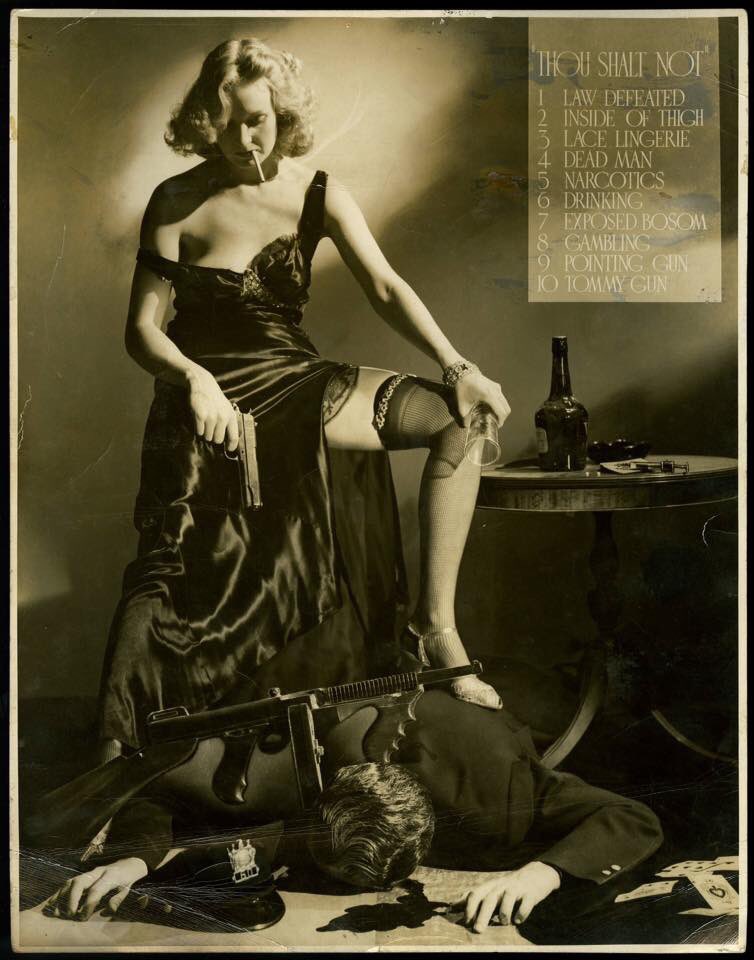
But if you watch a lot of old movies, you may notice that films of certain genres made after 1934 do tend to be a bit mild compared to "Pre-Code" films. This is particularly true in two popular styles of films--gangster pictures and horror films. With the gangster films, it became taboo to actually depict any kind of illicit activity, including gambling and drinking. The "bad guys" could never win. With horror films, many of the plot lines revolved around supernatural rituals that many religious organizations considered blasphemous and evil including the "scientific" concept of re-animating dead tissue in 1931's Frankenstein. In fact, many of those films were censored for theatrical re-releases after 1934.
By the late 1960s, the Code had become all but unenforceable and was replaced by the ratings system that is in place to this day... and there are still arguments over that (even from me). Fortunately, due to film preservation, many of those Pre-Code films that were censored later on have been restored to their former glory. While I've not read specifically what might have been censored from this horror classic to make it "suitable" for re-release after 1934, I assume it was. And even if it wasn't, when I do watch it, I'm taken by how creepy the film still is, 92 years after its initial release. I find myself wondering how different the film--along with Dracula, Frankenstein, and the other Universal horror films of that era--might have turned out if it had been made just a few short years later.
Cinematographer Karl Freund (who pioneered the three-camera system used today in shooting many television programs) directed this horror classic starring Zita Johann, David Manners, Arthur Byron, Edward Van Sloan, and--fresh off his star-making role as Frankenstein's monster--Boris Karloff as Imhotep. Originally released in 1932, this week, just for the holiday season, I recommend The Mummy.
Until next week, stay safe, be good to your neighbours, and please remember that if at first you don't succeed, then skydiving definitely isn't for you.
Yours in peace, love, and rock and roll!
The Reverend Will the Thrill

No comments:
Post a Comment